Nythera
|
| |
| Information | |
|---|---|
| Homeworld | Elyndra
Previously Chitara |
| Habitats | Dark and dense forests and jungles on Elyndra |
| Unique Traits | Membranes similar to butterfly wings, doll-like joints, antennae, fangs |
| Writer(s) | Dani |

"The flame which burns with color most unique is also the most delicate—let us kindle and protect each of our precious sparks in kind." — Nemain, member of the Morrigna
The Nythera are a bipedal, fae-like species that live in the dim, canopied forests of Elyndra. They are known for the butterfly wings on their face in place of regular eyes, alongside their extensive research into magic. They are long and slender humanoids with common traits being antennae, glowing patterns along their body, and a segmented tail with additional wing membranes along it. They live in clusters, small stone cities spread about under the shade of the forests. They’re a culture of magic and artisan works, famed for their weaving, textiles and libraries of arcane studies. The Nythera believe in self-expression and curiosity, yet their society is rather reluctant to let their people out from The Garden, believing much of the universe to be cruel. Only recently have they loosened their isolationist policies to interact with the other spheres formally.
Core Worldview
The Nythera believe in maintaining community, not wishing to leave the Garden Sphere. There is fascination in the great expanse of the sky, but after experiencing hardships long ago, they yearn for little but the life they have sown in Elyndra. They live short lives that decline with age, and so they are firm believers in self-expression; their lives are a candle that is meant to burn brightly until it dies out. With such fleeting lives, they treat death with ambiguity, almost something to laugh about amidst their elaborate funerary rites.
Their lives are meant to create and celebrate before they are consumed by their own magic.
Physiology and Design
The Nytheras are slender, humanoids with butterfly and insectoid features. They have long limbs, typically with jet black, bodies, but they may come in other colors as well. They sport antennae and their bodies appear segmented, almost doll-like in shape. They have long tails, and it is commonly accompanied by glowing patterns along their body. Such patterns can shimmer and flash in accordance with their emotions and thoughts.
They are able to spin silk, but they have no wings upon their back for flying. They were never made to fly. It is said the ancestors of the Nythera had wings, yet that history has long been obscured.
Their most defining feature are the butterfly wings on their face. They can move and emote, in which the “eye spots” on the wings are actually their eyes. They are not actual wings, at least not ones that can serve any purpose of flying, perhaps better described as delicate membranes mimicking them. These structures appear as they age along the Nythera’s body, usually starting at their joints and extending to their tail. More and more grow, getting exponentially worse in their later years.
Nytheras prefer to live in low lighting. While their eyes may be adept to most lighting, the wing membranes are not. Bright light for too long can lead to deterioration. The membranes become more transparent in prolonged exposure, until only the frames remain.
Their height ranges from 5’8” to 7’0”. Nytheras can “live” to their 60s, but this is a highly contested number. The primary reason is due to the nature of Serglige, making even the concept of death an ambiguous state.
Serglige
The Serglige, sometimes referred to as the “wasting sickness” is a long accepted consequence of the ancestors of the Nythera, having migrated to Elyndra to survive the demise of their kind. It is uncertain of the exact origin of Serglige, but it was coined to describe a common affliction that affects Nythera as they get older. The main symptom is a gradual growth of wing membranes. It starts at the joints and grows more and more, getting exponentially more severe as they age. The reason it grows exponentially is because these wing membranes hold magic. That means that as they grow older and gain more wings, their capacity for magic grows. It does not make them inherently better in skill, simply allowing them to store that magic. The Nythera get these boons, yet it comes at the cost of shorter lives compared to most.
It gets to a point that the membranes hinder their mobility and magic degrades their mind. Even the act of passing away is an ordeal in of itself, where one’s body is ladened with wings until it renders them unable to move. The overgrowth dulls their senses, even to pain, and ensures that death is a painless process, leaving only a mound of butterflies in its wake. This is where the matter of “lifespan” is debated. With their increased capacity for magic, they are able to maintain their bodies to sustain life and execute automated actions as per their casting.
There has been extensive research into mitigating the loss of one’s mind to retain their advanced capacity for magic and extend their “lifespan”, and there has been some success.
Food
Nytheras are omnivores. They are able to eat most vegetation of the canopies, greens and mosses and the sparse berries that flourish in the dim light. A lot of their diet handles mushrooms of all sorts, providing them some resistance to poisons and toxins local to Elyndra.
Despite their omnivorous palette, they lean into carnivorous diets. They kill and hunt local fauna, having sharp canines to tear into meat as needed. They often consume blood to obtain necessary nutrients, enabling them to preserve the meat for later. Some call them vampires for this; locals simply call it being resourceful.
History
The Nytherans originated from a sphere named Chitara. They were much different back then, once called an extinct species named the [REDACTED]. Due to an event named The Final Sunset, where a passing sphere consumed Chitara’s primary star, the surface of Chitara was plunged into eternal night. Unable to adapt to the violent change in environment, many of them died off. Whilst the other species went underground, the [REDACTED] fled the planet. What few remnants of the species ventured to Elyndra, where they were embraced and welcomed into The Garden. Since then, they have forsaken whatever remained of their origins, evolving to adapt to the magic of Elyndra. That, in turn, has created the Nythera of the modern day.
Social Structures and Community
The Nythera live in small cities scattered throughout the canopied forests.
Governance
The Nythera function in a sort of elective monarchy.
- Elective monarchy; sovereign (Ri), elected from
- Seelie
The Nythera function as a monarchy
- Monarchy (democratic monarchy)
- French government as inspo
- Two courts: Seelie and Unseelie court
- Seelie: Focused in magic research, military, and infrastructure?
- Unseelie: Focused in governance, operations, and diplomacy?
- Current monarch: N/Aa
Religion and Spirituality
The primary religion of the Nythera is known as Nil Taras (“not returned”). Its demonym is Tarasi, but the faith is sometimes referred to as “The Nil” or its followers as “Nihilists” as so crudely named by foreigners. The faith originated from when the Riodinia first ventured to Elyndra. Stories say that when they were struggling to survive in the forests of the Garden Sphere, the Nullstar had granted them the capability to thrive. Small, white lights danced across the night, and it led them to shelter. The stars were their only guidance. Such good fortune was granted until one night, in their dreams, a small white butterfly whispered, “Give up your old face, with eyes that have wept too deeply. Discard them, and you shall find all one needs to make the wilds home.” In their desperation, they accepted their blessings. The wings upon their backs were discarded and traded for new ones, sprung from their limbs and face. Those would inevitably become the Nythera they know of today.
”In exchange of this blessing, you, too, shall be entwined to terminus.”

Tarasi view the Nullstar as a distant, reverent entity, god-like in presence. It is not quite a god in their eyes, not a creator god of any sort. Though they commonly personify it for the sake of storytelling, it is treated as an endpoint. The Nullstar is what tethers the threads of the universe into a singular terminus that all things march towards. These threads are a gift, proof of their magic and the interconnected nature of existence. They revere and worship it, yet it is also the distant inevitability that makes the Nythera unbothered by the idea of studying the Nullstar. Divination is considered a more sacred expression of magic, as it is the only way to “commune” with the Nullstar to learn whispers of the future. While it is treated like a personified entity, they have an inherent grasp of the inhuman nature of it, seeking neither comfort nor retribution. The Tarasi only seek understanding.
Common Tarasi beliefs may make one believe they are fatalists, nihilists that hold no care for the world as they are always fated to die. That is mostly false. They understand the universe in regards to entropy. All things are fated to break down and be reduced to the most basic threads of existence; they especially understand this for themselves. The Serglige is a natural byproduct of their magic when they were at their lowest, and thus, they accept the fate of their shortened lives with dignity. Nythera may study it in pursuit of mitigating its harm or extending their lives, but there is no shame in giving into their affliction. It is simply the Nullstar’s will, the tug of one’s thread. It is only in this acceptance of being undone that they may find freedom in self-expression. If they are not to live long, then let them shine. If their lives are even the smallest spark compared to the Nullstar, then it is a life well lived.
In addition, they find change to be natural, like the change of oneself in name, appearance, or character. They see it is natural for the world around them to change. This belief is somewhat contested by their reluctance to follow those beyond the Garden Sphere, but there is some argument that while change is welcomed, there is a difference between the change of an individual and the change of one’s faith. Even death is nothing more than change, the Serglige creating a liminal state between the death of the body and the death of the mind. Only in severing these threads may one know true rest.
They believe in reincarnation rather than an afterlife of Heaven and Hell. When a Nythera dies and is buried, they are bound to the threads of existence. They may be changed in form, but they will inevitably return to make their descent to terminus once more.
Hierarchy
Nil Taras has a simple hierarchy, yet a lot of one’s standing depends on either their capabilities in divination or how they are tasked to handle the dying or deceased. At the top is the Calliach, followed by the Morrigna, high ranked diviners that directly serve the Calliach. Under them, their believers are split into two groups, the Druids and the Fianna. Both groups manage the rest of the populace, either in general management and organization of the Tarasi events or combat and security.
The main figurehead is someone called the Calliach (“Veiled One”). She is said to be an elder Nythera, an entity far beyond her years of existence and one of the few consistently successful individuals that has retained her mind despite the Serglige. She is revered and studied, hoping to bring salvation to those seeking her wisdom and magic. She resides in the Tower, in a wing called the Final Hall. In what little movement she can muster, it is said she spends a decade weaving a grand tapestry upon her loom, the Shranga Nialish (“Strings of Null”). At the end of that decade, she reveals it, said to be divining the threads of the Nullstar itself. It divines the future of Elyndra, setting the tone of the current governance of the Nythera.
Beneath the Calliach are the Morrigna. They are three high ranked diviners that have been selected personally by the Calliach, usually serving for life.
Following that are the Druids and the Fianna. The Druids are straightforward; they handle the daily operations of the Tower and other Tarasi establishments across Elyndra. They pray, handle event organization, and manage the civilians. They lead worship and train apprentice mages, in which they become diviners or go into other arcane practices. Some of those apprentices are sent to the Fianna. Otherwise, the Druids manage general operations and occasionally communicate with the Monarchy for government issues.
The Fianna are more adept for fighting. They are the sword and shield within Nil Taras, more militaristic in formation. They manage security to protect Tagranach and the Tower, alongside training apprentices to be more combat adept. Their magic and senses are honed for battle, as they face more than the beasts of Elyndra. Of their duties, the most sacred would be their task to put the Nythera to rest. The Fianna are tasked to grant rest and burial to those that cannot, execute the will of the deceased, and host events in memory of them. They could be considered “death knights,” but perhaps a “funerary procession” is better suited for them.
Funerary Rites
Funeral procedures are a key aspect of Nytheran culture. It is one of the core duties of the Fianna. Due to the nature of Serglige, that phenomenon has shaped their perception of life and death. Life and death are concepts considered in loose terms, a liminal state, a fine line to waltz upon with abandon. Despite the ambiguous nature of death, there are rather strict procedures for burial. This is for consideration of the living and departed, as Nythera that have succumbed to the Serglige may not be given rest. To ensure proper funerary rites, the Nythera experience 2 deaths:
Bas na Feola: The first death. It is “death of the flesh,” where the body has succumbed to their wounds and injuries. When the toll of mortality has become too great—or when the Serglige has consumed their mind and burdened their form into stillness—that is the first death. The body ceases to function as it once did, leaving only a husk of what used to be. Outsiders would consider this a proper death, as they may appear unmoving and resting. This is not always the case.
Bas na Hanam: The second death and the final rest that allows for them to be given burial. It is “death of the soul.” Sometimes, it is a death that happens coincidingly with the first, like when one is slaughtered by a foe. In many cases, if a Nythera has a decent enough capacity of magic, the body shall endeavor contrary to the host. The habits of one’s life are etched into the soul, so their magic may instinctively resume those habits to feign normalcy. It is akin to a dying wish, mimicking those habits mindlessly ad infinitum. The term is a little deceptive, less of a destruction of the soul and more to release one’s soul from the husk, requiring the halt of its ability to use magic.
Ensuring the second death is the first step in funerary rites. Whether they wish to enact Bas na Hanam is at the discretion of the husk’s related party (be it family, friends, or primary affiliated group). When it is decided, the most common method of a second death is taking the body and laying it out in the sun. The prolonged exposure of the wing membranes that store mana to light will cause them to wilt and dry. Depriving the body of its ability to store mana, the husk will cease to function.
Once the second death is confirmed, the dead are commonly returned to the relevant party or family. The body is usually dressed in silks woven by the family or loved ones. They are commonly buried with crafts and things held dear to them alongside a funerary veil of sorts. It is web-like in patterning and akin to lace in material; it is laid across their face, since the wing membranes of their eyes cannot close naturally once deceased. It is meant to obscure their face with intricate patterns, representing the culmination and “entanglement of one’s life.” The family may hold a vigil in their send off, accompanied by a song or dirge. Only then, may they express their sorrow, but if they do, they must turn away. Departure is never truly the end; they will reunite someday.
The dead are commonly buried with mushrooms and other plants to ensure they decay and return to nothing quickly. If the family or party does not immediately bury the body, they may keep it in some stonework coffin to hold for later burial, such as delaying to bury them during Marvfesh. Rarely are they buried enclosed—thinking the body and spirit confined—when it is meant to rot and return to the earth. Only when it can be returned to nature that ties existence together by threads can they be given peace. Never are they burned.
Technology and Science
Unlike many other planets that either rely on technology or integrate magic into technology, the Nythera preferred to rely on magic for their lifestyle. They have a greater capacity to store mana in their wing membranes with age, allowing them to use magic more extensively before exhaustion. Their aptitude for magic is not derived from the born talent of their species, but rather their culture. With a culture known for weaving and silks, they have an easier time grasping fundamentals to understand magic as “strings to be woven.” However, even with that understanding, their magic can be volatile without proper handling. Common negative consequences of overusing magic may include exhaustion, mutilation (if magic is focused on a particular body part for extended periods of time), and damage to one’s mind. It may damage the soul in extreme cases but it’s rare. The Nythera often partake in rituals to better attune them to their environment to improve their control. Common components include fungi, flowers, and blood, and they are commonly carried in pouches for convenience.
They interact with magic in the way they interact with silks; they pluck strings like an instrument, or they weave the threads together. The Nythera may cast spells utilizing vocals: they hum or sing, and some even use instruments as a medium, plucking at the strings of the arcane. Some of their most prolific mages were singers and dancers.
As for their technology, it is not as advanced as their other planet peers. They see little need to compete on that front, sufficiently integrating technology into their magic to automate and enable mass production with less active oversight in those matters. Aspects of textile manufacturing, agriculture, and other essential functions are a few of those works automated by magitech. They may also utilize alchemy and potioncrafting due to their familiarity with herbs and how these components interact with magic.
One such common integration seen around Nytheran settlements are constructs forged from magic and tech, completing a variety of tasks for day to day life or general safety. Though many Nythera prefer magic, there has been a change to study and integrate more foreign technology as more foreigners visit Elyndra.
Divination
Divination is understood as the practice of foretelling events by grasping the threads of the universe. It is their effort to comprehend the Nullstar, weaving threads of causality into a form that could be interpreted. Nythera have a particular means of divination, but it is also one of their more prolific manifestations of magic. It is a taxing ritual, in which they weave together large, intricate tapestries made from their silks. Many mages come together to perform and interpret into messages and prophecies. They are known to be remarkably accurate.
Many diviners work with their religion, and some have participation in government, where they present divinations to the Seelie and Unseelie courts to deliberate on policies and governance. However, it is not a requirement to be a believer to practice divination. They simply get the easiest access to other diviners and resources to perform their divinations, thus improving the quality of their tapestries. Most diviners hail from Tagranach, trained in their youth. Many that utilize this magic regularly may have callous, damaged, or even disfigured hands. The more prolific diviners may have decorative claws to obscure and protect their damaged hands to continue weaving.
Traditional Clothing and Fashion
Fashion is a major aspect of society. With their major industries in textiles and artisan crafts, they have a wide variety of attires to sport. The only restriction on clothing is the consideration of their tail and the wing membranes along their body. They can cover the wing membranes, but it is ill advised to constrict them with tight sleeved clothing. Their fabric is high quality and durable, often having complex embroidereries.
The Nythera like to wear accessories such as jewelry with gemstones and draping fabrics. It is common to accessorize their tails with bands and bags to carry things. Sometimes, they even do piercings.
Occupations
Common occupations include weavers or anything in textile manufacturing, performing arts roles, musicians, artists and other artisan positions. There is also a significant population that practices agriculture to sustain them.
Their most known occupations, outside of governance, relate to magic. Many Nytheras are mages and researchers, skilled in magic for a variety of uses. There is a notable size of teachers to educate both their own people and outsiders that have started to frequent their populace.
Starships and Space Travel
Due to their distant origins from Chitara, they do have the capacity for space travel. They have the remnants of old technology for when their ancestors fled during the Final Sunset. Though their fleet is far and few, they have worked to ensure its functionality. There are a few newer models too, some almost insectoid in silhouette. However, their technology is relatively outdated. It works fine enough, given it has some modifications to adapt the old technology and their magic capabilities.
Despite their ability to do space travel, they would prefer not to. They understand the need to leave and interact with the stars, but they would rather not. Leaving Elyndra with the intent of forsaking the Garden Sphere is frowned upon. Attitudes towards space travel have changed in recent times. There were already changing sentiments leading up to the mission to go to The Anchor, but the mission solidified it further. Now, space travel is treated with ambivalence. As long as their travels are for their people, it can be permitted somewhat.
Cultural Quirks and Daily Life
Festivals
Given their short lives and expression of magic and arts, they like to hold parties. It uplifts the spirit of their people and maintains friendly relations with the Slythae. It’s their means of instating their new sovereigns and how they enact diplomacy with others. The art of constructing such festivals and parties is a key skill of Nytheran politicians, however frivolous that sounds. Etiquette and decorum is a key aspect of it, however unorthodox it may be at times. Aside from their regular congregations with the Slythae, they have numerous festivals they host throughout the seasons:
Marvfesh: (“elegy”) It is a festival in memory of the deceased. It celebrates their life and the ambiguity of death. It is also a day dedicated to putting their lingering elders to rest, if they are deemed “deceased in the mind.” Those laid to rest in these days are considered
Fayla Blahfar: (“blooming festival”) A showcase of the arts across several days, celebrating their artisans in a complex gallery of sorts. The main events are showcases of their tapestries at dawn and a performance at dusk.
Glor na Morrigna: (“Voice of the Morrigna”) A religious festival at the start of the year. It is mostly a formal celebration of their faith, giving offerings and visiting the Calliach’s abode. The festival ends with the Morrigna divining for the Nythera. It grants the year good tidings. Once a decade, the Calliach imparts her divination, in which those special variants of the festivals are called the Glor na Calliach (“Voice of the Calliach”). The tapestry is gifted to the reigning monarch as an omen for their rule. This is the only festival that takes place exclusively at nighttime.
Arts
Due to their masterwork in spinning silks and weaving cloth, their culture has always had an emphasis in the arts. Why dream of the vast expanse overhead, when all over could ever dream of laid at their feet? The fine arts are integral to their society, best known for their textiles and performing arts. They have a culture of gift giving; the act of crafting for another rather than mere purchase is considered common practice. Mass produced items as personal gifts (for special events such as holidays) is considered rude.
Magecraft, in their eyes, is also considered an art. They spend day and night honing their craft. They host several schools and facilities to study and perfect their understanding of magic. Due to their greater capacity for magic, they are one of the more magically competent species.
Artisan works and textile manufacturing are their primary exports. There are also several significant idols and mages that gain traction amongst Elyndra and other planets.
For their performing arts, music is their main art. Most folks learn some string instrument if they aren’t trained in weaving, as it aids in understanding the fundamentals of magic. Their primary instruments are strings and vocals alongside the occasional percussion instrument. They call their style of singing Macalla Nos (“echoed style”). Their vocals utilize a lot of vibrato, operatic techniques, and melismatic singing. They have the capacity to distort and echo their voice slightly, using magic to that effect for more varied music. This may cause discomfort to the listener if they are not adjusted to Macalla Nos. Such distorting effects may be applied to string instruments, too, as both are a means of channeling their magic.
Etiquette
Etiquette is not something that is all-consuming in their day-to-day lives. However, it is a key aspect of their celebrations. The Nythera have particular rules as a sort of decorum they adhere to amidst festivals and especially during diplomacy. Failure to adhere to these rules could be considered a faux pas and result in needless conflict. Specific rules may vary between festivals, but the more common ones as follows:
- Names are rarely spoken aloud during festivals; titles or epithets are used in place. Using one’s name is akin to a direct challenge or perceived as hostile.
- Do not spill or waste any drinks.
- If there must be gifts, bring them in pairs.
- Do not thank each other, it implies debt to the other party.
It is never clear as to when or why they established such decorum, exclusive to their festivities. Some say it was a lingering habit of a flourishing bygone reign, eccentricities mimicked in hopes of inviting good tidings. Others suggest it is a means of protection; celebration may be seen as a point of weakness, so such rules are a means of warding off ill omens. The occasional outsider remarks that these customs only remain due to the sheer amusement it brings to inconvenience outsiders, akin to one convoluted inside joke.
Who knows.
Misc
- Their stories and mythos often put things in pairs or multiples of 2. A lot of their traditions reflect this, too. It’s because their time of unity with the Slythae only comes twice a day, one at dawn and the second at dusk.
- Imagery of dawn and dusk is also prevalent since it is the few times that is not too bright for the Nythera and not too dark for the Slythae. They often hold festivities and parties at dawn and dusk, too.
Notable Locations
Elfame
Elfame is the name of their most prominent city, their capital of sorts. It is the largest gathering of Nythera, where most of their economic and government activities occur. It is a sprawling city at the heart of their innumerable canopied forests. Here lies the heart of their governance, where the monarchy resides. This is also where their educational institutions for magic are focused in, too. The performing arts thrive in this place. Anything that’s worth anything will likely happen here, be it social or magical in nature.
Tagranach
The second largest city, far north of Elfame. It is colder and their forests are more evergreen, accompanied by fungal canopies. Here lies the heart of their religion. It is where the Cailliach resides to share her wisdom of the Nullstar. Most divinations will transpire here due to available resources. It is surprisingly peaceful, albeit uneasy to outsiders with the “faint, looming presence of death” as they say. A lot of musicians and weavers congregate here.
Other Settlements
Skaaglen
A settlement of magic and ends, southeast of Tagranach. A lot of arcane scholars arrive here to study the dead and how mana flows through the bodies of elder Nythera. With the old age of Nythera suffering from the Serglige, many have been reduced to mindless husks that behave like puppets; they are reduced to their old routines, sustained by magic that consumes their body. It is sometimes called the “Cairn,” as it is where some Nythera are put to final rest. It is decorated with numerous cairns scattered about the settlement.
Fieltan
It is one of the more prominent places to conduct festivals or business. West of Elfame, it lays at the edge of their canopied forests. It is a settlement that is mostly decorative, a sprawling open town with plenty of space for party arrangements. It is occasionally called the “Half-Light” as it is distinctly presented as a place literally half in the shade, half in the light.
Interactions With Other Species
Nytheran-Sylthae Relations
The Nythera and Slythae have coexisted for a long time. Perhaps, there was once a time they avoided each other by nature of their opposing constitutions; one required the sunlight to thrive while the other had to avoid it. That has changed, given their shared affinity for Elyndra and capacity for magic. They have found ways to coexist and thrive together. It also helps that the Sylthae are lax in nature, making it easier to communicate on peaceful terms.
All of Elyndra has a culture of “party hours” throughout the years and days. These include annual celebrations, but also the casual festivities that occur every dawn and dusk. Parties at Dawn are hosted by Sylthae in honor of long sunny days ahead. Parties at Dusk are hosted by Nythera to rejoice in the dim glow of moonlight all night long. While Sylthae and Nythera may celebrate these separately, they often come together in “Party Towns” to celebrate together. This is a very special bond since dawn and dusk are the only times where it is light enough for the Slythae and dim enough for the Nythera to coexist. It is also why Nythera values things in pairs, for the dawn and dusk that brings them together to their Sylthae peers.
Relations with Foreigners
The Nythera are generally wary of foreigners. Though capable of space travel, they once had more isolationist policies as a means of protecting themselves. They had minimal reason to expand their trading or seek more territory due to their constitution and general dislike for leaving Elyndra. In the recent decades, they have significantly lessened these policies. They accept all sorts of visitors who had ventured to study their magic and arts, however, there are numerous regulations for them. There are few outsiders that stay for the long term.
They are generally indifferent, if not cautious, towards most species. They are especially cautious of Carcids and Lepterans, as they have been made into tall tales by them like boogeymen that caused the Final Sunset. The only other species they are particularly guarded towards are the Aurelians, as they see them as an imperialist group that wishes to smother their capacity for magic. They hardly entertain their “guidance” when they must participate in diplomacy.
Concept Art
-
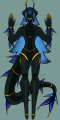 Art by Dani @duckitape
 -
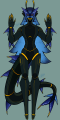 Art by Dani @duckitape
 -
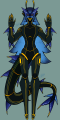 Art by Dani @duckitape
 -
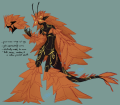 An elder Nythera individual.
Art by Dani @duckitape -
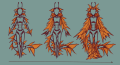 Progression of the Serglige.
Art by Dani @duckitape -
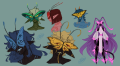 Many colorful variations among the Nythera.
Art by Dani @duckitape -
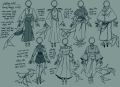 Concepts for Nythera clothing.
Art by Dani @duckitape